Showing posts with label Digital Media Development. Show all posts

Thursday, 26 November 2009

Cinematographers Perspective:

To conclude the documentation, i have trawled through the work produced to date, and wished to share some of my most cherished produce from the years last scheduled project. Below lay two screen shots from the developing film Nosey Neighbour. The shots i have decided to speak about are from the point of view of a cinematographer, with a slight hint of art direction and continuity.
First of the bat is this beautiful shot:


For those who have no idea on the concept in the story, at this point she is staring through a peek in the blinds while watching off a disturbing neighbour leave her drive. On location we came across the issue of how to film the shot without needing to venture outside. Somebody mentioned just move the actor from the window. But this would have looked odd. We needed to get here as close to the camera, and the camera as close to the window as possible. Then there was the issue of lighting. The natural light from behind the camera and myself would cast a shadow. So with a soft spot light we recreated the light flooding onto the face to give the effect she is still up against the window. Thus giving the viewer the comfortable transition of continuity between behind and front cuts. In addition, the shot just has an extra quality about it that stands out from the rest as a result of this bizarre lighting technique.

This is my very close second favourite:

This shot unbelievably comes directly after. My two favourite visuals both together right towards the end. Need to learn how to spread them out slightly! The quality of this image is the colour. The shares of brown and cream, very mundane and neutral colours representing a nice vision, also the central "symmetrical" positioning feels very cinematic. Apart from that, its just a personal favourite. Enjoy

Monday, 23 November 2009

Paper To Screen: Story visualisation in comparison to film footage

Torture Sequence:

Here are a selection of comparisons showing how much my composition for screen has improved this project. Being the storyboard artist, and the onset Camera operator/Cinematographer. I feel this job is by far the most important task i undertake in the production. This means making sure i have the correct composition before going on location. And ideally even thought we only did it for one of the projects, we should be framing on set with the actors as a "dress rehearsal" kind of idea

Below are two examples of the comparison:


Torture Sequence:

Same again but with the torture sequence:

Tuesday, 17 November 2009

Nosey Neighbour Shoot: My Overview


The second shoot of the week, and to be bluntly honest, it was previously my least favoured of the two. With that said, i would possibly be eating my own words, with the location being set in my home, it was a rather strange experience. Theres no truer experience of bringing your work home! This fact gave me a sense of comfort, as i could snack as and when i pleased! All jokes aside, i was really disappointed with using our home as the location. Down to facts such as lack of preset art direction, warmth or even feminine impression to the rooms we shot in, Using the "backup" location for the production literally put me straight off the idea of salvaging any usable material for showreel. This would be the case in if the above theory to these lacking conditions were to come true.

Regardless of these negative vibes presented, i took the shoot in my stride, and tried my upmost to take the job seriously but keep relaxed and even fun, with the hope of it being educational to my skills. This attitude worked wonders when it came to the day of the shoot. Not only was the situation an enjoyable one, and not only did it flow smoothly, but most importantly for me, i learned some valuable lessons, and with fingers crossed some decent footage. Hopefully from what i have seen, some of my cinematography focus looks to have paid off. but more on that at a later date


Looking at some lessons learned would most probably be the idea to stop immediately judging situations and even people for a more personal matter. This habit of mine, only appears to divert me from where i would like to go, or in this case, what i would like to achieve. Lesson well and truly learned

The cast were very nice to work with, as always, however working with difficult is something that we all was looking forward to doing with a certain actor for the torture shoot, but he was too unreliable to risk a no show on shoot day. John was the camera assistant that the producer had fished up from the film club down at vernon street. Although i really did not utilise this chance to the maximum, i still managed to let go of my precious grip on the camera slightly to allow john to operate, and i could then take more of a backseat camera directing role. Was a great experience, and i shall be doing this on my final major next year.

Monday, 16 November 2009

Torture Shoot: My Overview


The first shoot is in the can so to speak. One very evidential problem that was reassured after the shoot, the issue of planning and the way it is approached. More specifically, i solemnly had the belief that the use of hand drawn storyboards, even storyboards from more photorealistic media formats were both a considerable waste of time to produce in consideration to what there intended use is on set. (Barring the use for shot composition). However, i have no real answerable reason to solidify my belief in this. Before the start of this projects pre production, i took it upon myself to investigate this unanswerable belief in the use of storyboards and aim to underline a legitimate reason to why they do not seem to work.

After spending time theorising on the most productive approach to distributing the storyboards, as previously mentioned in a previous post. The document i finally produced had a very easy to follow system using colour co-ordination and numeric structure to allow our additional crew to make sense of the productions process. These techniques can be understood by infants, so in theory should make it slightly easier to understand. Getting a universal understanding correct was a vital issue that had to be addressed on location. If the document could be understood by someone who has never previously read a storyboard or shot list document, then the careful planning into the creation of the document will have been a success.

After numerous meetings with the cast and crew. Delegating copies of storyboards, talking them through the story, and with the crew discussing the theory behind the shot list. It appeared that they got a "general overview" of the production. And this circles back round to my question of how does the storyboard help in these situations? My deliverables go as follows:

I first of all had a belief that a storyboard was an aid to quite literally tell the entire story to everyone involved in the production. Now i realise how utterly stupid of an idea that is. How can one persons visuals be put across for a second person to get the exact same understanding? its not going to happen due to personalised interpretation. The result will always appear different. In addition how can a series of E.G 30 still images represent thousands of moving frames, even with no cuts involved, never mind simple cuts, or even complexed transitions.

So in conclusion, There is no way i am using these documents in the same light again, yes for composition and rough cinematography, they are great for that. Any other process is now obsolete. I shall look for replacements to fill the gaps in the upcoming projects.

The production as an operation was a very enjoyable experience. Regardless of the fact that our pre production was not as strong as it could have been, what we did accomplish in those early stages enabled us to feel comfortable on set, with a stress free focus on what we were doing an when it was to be done in the schedule we had set.


Torture Shoot Photo's:

Friday, 30 October 2009

Ready and waiting

Wednesday just gone. Myself and Graeme caught up with our additional crew members Jon, Jo and Mia. The meeting was literally a situation to talk through the storyboards and shot list comparison. This gave the crew a rich knowledge of the plan for the scheduled shoot coming up, and allowing them to feel comfortable in there designated roles, more so Jo, as she will have to be very independent and proactive on set. Normally i have struggled to communicate and feel at ease around people i do not know well, so far i have taken this opportunity to build my personality with colleagues to develop a solid relationship in preparation for the shoot. Lets hope this shows through in the outcome!


After previous discussions, we made the decision to give john the position of camera grip. In this briefing on Wednesday, I gave Jon a standard operational induction with the sony XD camera and lens mount. Knowing he was already camera literate, he really did not need this induction, he was naturally able with the equipment. although providing Jon with his on set roles was a vital issue that i needed to get across so there is no clash in interest when the camera is in operation on shoot.

With that said, the production is ready to get the good old lights camera and action. Will report back to blogger once the production has been canned, with thoughts and evaluation of the working day.

Until then! Wish us Luck!

Saturday, 24 October 2009

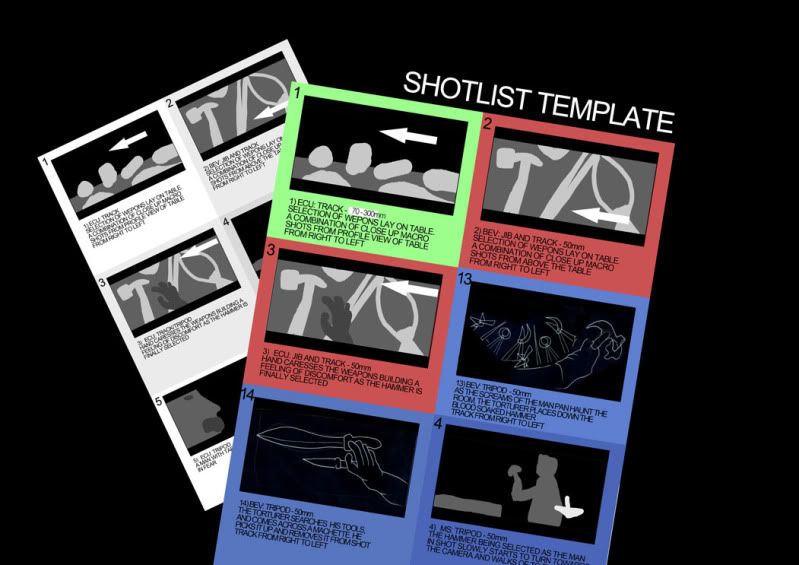
Shotlist: Keeping things ship shape!

After compiling the storyboards together and collectively analysing them for final production. The mentioning cropped up in a conversation regarding shortlists. Now until this date, i have never produced a shot list for a production. After trawling various websites and a few books in consideration to the creation of this said shot list. There are various methods to generate shotlists through software. To be fair and honest, these may work for some collectives, however the idea of installing software to do a job such as generation of a shotlist seemed a tad inappropriate for the needs that we request from a shotlist.

However inspiring and productive to see these techniques were, my personalised shotlist was more of a highbred storyboard. Providing that visual into the same document seeped the most appropriate methid to approach in the creation of these documents.


The document had a very easy to follow system to allow our additional crew to make sense of the productions process. This would be most crucial for jo, the continuity and shot list co-ordinator. The process behind making the document easily understandable for a non film production orientated being was to use formats that most people can relate to with no real difficulty.

How did i approach this? by using large thumbnails which are near enough shot by shot relevant, the crew were able to visualise the next shot in the sequence. Speaking of sequence, i organised the shot list in order of various priorities. These priorities were issues such as continuity (especially in the torture sequence, considering the use of SFX make up on actors) Another very vital priority was the use of equipment. When ever possible the shot list would group together equipment used in conjunction to where it is used. So for example; all the crane shots were put together for a start. then they would be placed in order to how far the equipment has to travel between shots. Also to add confusion this would come second to the continuity of bloody make up effects being used.

Those theories should keep us in good stead for the shoot, Fingers Crossed!

Thursday, 22 October 2009

Location, Locaion.. Oh wait maybe not!


Temple Mill


After Weeks of waiting and hoping following the very motivating recreational visit to Temple Mill in Holbeck, We have now reached a point where waiting for the location to materialise is casing a threat to the productivity of the schedule. As a result we have now chosen to opt for a backup plan of the studio theatre in the college. But again, booking the studio theatre a couple of weeks before you need the space has again proven near on impossible! So to "plan C" in theory.

We have successfully booked the second photography studio based next to the ceramic studio, this is located in what feels like another world in the deep bowls of the resistant materials quarter of the college.

However, the room does seem sufficient, although art direction will be taking a heavy directional shift, it is something i am already aware of and have had experience with previously. When i say this, my plan will be changing from relying on the much sought after location backgrounds which looked the part of a "torture location" with huge space, allowing freedom of movement and great depth to the camera, to a smaller photography studio with no interesting or even "relevant" background detail. The plan in mind will eliminate any background detail allowing the visual to look and feel like a huge room with very little lighting, this would appear black as the walls are not visible in shot due to the lack of light.

Here is some previous work i have produced to provide an example of this dark open space feel:

After Effects Demon from Mark Braithwaite on Vimeo.

Tuesday, 20 October 2009

Tools or Weapons?

Did a little scout today to discover some nice hidden gems in my granddads workshop.
There was quite literally around seventeen and a half million Weapons "oops" i mean tools

To those familiar with the recent projects i am partaking in, will know with out a thought that these are props for the torture
scene. And if not well these images are of nice tools that we plan to use for weapon props in a short "torture porn" sequence


These images are but a minor amount of what was found in the rummage. It is quite safe to say that there is going to be no problems in the art direction for the weapons department. All we need now is everything else! including a secure location

Friday, 16 October 2009

Got Wood?

Not too long ago back in the early days of october 2009 we all went on a little adventure. After trying all morning to contact both local joiners and corporate giants like Homebase and B&Q. We got a hint on some wood offcuts being stored at the B&Q on the A64 up Holbeck way. As you do , we sporadicly jumped into the car to seek out this wood.

To our amazement there was a good 20 to 40 pounds worth of wood going cheap. We pushed a little banter onto the woodsman and he let us take it away for the amazing price of £3!! yes absolute bargain!
Photobucket

The wood will aid us in the set building process for the seance sequence we are setting up in the lecture theatre

Thursday, 15 October 2009

Digital Media Development
Research and techniques

Again similar process to the last test sequence, The more experiences i can squeeze into this academic year, the better i will become ultimately. I felt a genuine amount of confidence with the XD camera and its additional lens counterpart. It seemed almost like i have always known how it worked. Of course, having a sound knowledge in still photography and the advantage of how the lenses work set me up for a very nice head start.


Below are a set of screenshots taken form a second short experiment we produced. it was a simple idea to create tension through a staring competition using the camera alone to frame shots


and to top it off, it was still putting the 180 degree rule into great practice! a very productive day indeed!! Lessons well learned
Digital Media Development
Research and techniques

The plan behind this next section of research exploration was to test specific camera techniques that were presented in the project proposal. These would include methods such as: Pulling the focus and crossing the line (180 Degree Rule)

180 Degree Rule
The 180° rule is such a simple technique, yet something i have not fully realised and quite hounestly neglected in previous productions. Known for being a basic guideline in film making, it is a method that i intend to know inside out by the end of this production.


In a short sequence, we put the rule to the test taking extra care to follow the rule to perfection. Below are some screenshots providing a visul of the sequence.

Notice how both characters stay on the same side of the screen. when watching the sequence it soon becomes obvious to why the rule was implemented. It aids footage to run much smmother with a natural feeling.


If the camera passes over the imaginary axis connecting the two subjects, it is called crossing the line. The new shot, from the opposite side, is known as a reverse angle. However, when this rule is broken, it cal look very odd and disrupt the flow of the sequence. This shot below pictures the characters from behind. This does break that rule, although when watching the sequence, it feels like a very natural cut. The reason for this can only be one thing, and it seems pretty obvious once you watch it armed with the knowledge that the shot is from behind.


The session was a great sucess and provided everything that we intended to gain from the research.

Wednesday, 14 October 2009

Digital Media Development
Research and techniques

Seance Research: Drag Me To Hell

This film is quite literally a pile of dog shit, however, as far as its seance scenes go. There is quite the possibly that we can salvage some tips and techniques on how to set dress a room and more importantly film such a bizarre series of events.

The seance clip has bee posted on youtube. The opening few shots are great to present to a viewer that something manic is going on in the room.


In addition the room that the seance is being held is pretty much what i would expect from such an activity. Low candle lit lighting, vintage furniture, high ceilings. An old rich mans mansion feel.

Tuesday, 13 October 2009

Digital Media Development
Research and techniques

Torture Mood board

Some more Torture visuals to fuel the decisions in the execution of the film. Especially decisions such as set design and colour treatment

Digital Media Development
Research and techniques

Seance Mood Board

Monday, 12 October 2009

Digital Media Development
Research and techniques

In the previous posts regarding the torture sequence, it has just come to realisation that covered the main concerns but one. That is the torturer. Although the Saw films provided a great reference for all the other aspects of this sequence. The one thing Saw does tend to approach differently to how we have planned our sequence is the role of the antagonist. The antagonist in the Saw films operates remotely, setting up self harm scenarios. We are looking for a one on one aggressor to victim situation. This then pointed in the direction of The Hostel Films.


The first detail i wish to point out in these films is the issue of a costume or in a more traditional sense "a disguise" Something that removes your personal identity from the victim. We have discussed the matter of costume and are still debating on the options of a balaclava or keeping the face exposed. The decision to consider the balaclava is down to the social stigma that the wearing of one may suggest an aggressive and somewhat rude personality stereotype.

Saturday, 10 October 2009

Research: Visual inspiration

Interrogation Sequence

The Interrogation Sequence:
Using a combination of carefully planned camera techniques and organized fight choreography, this sequence will provide an action packed blood curdling torture session that will get the adrenaline pumping.

When considering art direction and location in this sequence, by carefully planning and giving consideration to detail will ultimately make or break the success (or failure) of this particular sequence. Again the main point of this sequence is to develop an understanding of the relationship between choreography and film. Ultimately for my personal education, I intend to really dig into the use of the XD camera with the Canon lens adapter. However, being in control of cinematography, i deeply feel the urge to sucseed in the art direction on set. My hope is that even if the choreography does fail, we may be able to salvage some visually stunning footage from the shoot.

To aid with this decision on art direction, I decided to opt for the now typically cliche saw films. As horrifically cheesy they may have now become, they still manage to create some exceptional visuals in the films. Saw films are the closest "hollywood standard" reference to gain a visual aid on set dressing a location for a torture scene. There are other considerations such as the "Hostel Films" which are equally as impressive, but in my opinion fail to provide the same cinematic quality to them.

Below are a couple of screenshots from Saw II & IV. Although being two feature films apart. they both share very similar properties. The obvious similarity is the acid green colour grading used on both scenes


Other shared qualities can be picked up when watching the scene. The next of importance will be that both these screen grabs are shot in a very similar fashion, and both feature a victim, tied down, somewhat unconscious and in a very secluded, run down and dark location with alien objects surrounding them.

These visuals provide great techniques on how to introduce a torture victim into a scenario of such terrible circumstances.

Below are some stills taken from the opening scene of Saw IV. The sequence is set in in a morgue, with a very cold colour grading to footage. This suggests the cold feeling of death most likely? The main interest of these stills is the method used in filming a selection of cutting utensils sat upon a table. As we have planned to film a very similar sequence, this research is imperative to develop from. The only real difference between the Saw sequence and our torture version, is that we wish to imply an additional sexual reference to relationship between the weapons and the torturer.


Wednesday, 7 October 2009

Personal Directives:

As mentioned in the project overview, the working group have been designated jobs to carry out thorough all areas of the production process. These are some short descriptions to what my jobs will be and what they may entail:

Preproduction

Storyboard/Pre visual Artist:
In preproduction, I tend to prefer taking a backseat to any real role. To send myself out of this my comfort zone, I shall be in control of the storyboarding and concept art for the duration of the project

Production

Cinematography/Camera Operator:
This job is a job assigned by preference, and in belief it is also a strength. The role does tend to piece together with the pre visualisation quite well.

Post Production

Special Effects:
One specific sequence demands a call for the use of visual effects. The effects will be in camera, and in postproduction combined. This job will be a challenge by providing the possibility to learn new skills and techniques. In addition, i shall also overlook the editing sessions to supply a fresh set of eyes, and catch out any mistakes that the other person may have missed.
Digital Media Development

The sequences:

There are a total of three sequences in the preproduction pipeline at the moment. The idea behind each individual sequence is directed to exploit specific techniques and emotions that have been a failure in previous projects, or alternatively something that is a desire to accomplish. Find below short synopsis and descriptions that demonstrate in more detail the theory of the project.

1.Suspense Building Drama:
This sequence will concentrate on long establishing shots to deliver a feeling of being trapped. A big benefactor for this sequence will be the combination of an atmospheric track and soundtrack to capture a cringe worthy feeling of isolation.

2.Aggressive Torture:
Using a combination of carefully planned camera techniques and organized fight choreography, this sequence will provide an action packed blood curdling torture session that will get the adrenaline pumping

3.Séance:
The séance themed scene will provide a chance to dabble in the field of visual/sound effects. The plan to produce an intense suspense followed by a supernatural disaster, the sequence will provide a great opportunity to build a studio set.
Digital Media Development

This is a short introduction to the project, and what the main objectives will entail

In a nutshell:

Create three short sequences (30-90 seconds) that strengthen and develop a various amount of specific film making techniques, in consideration to possible weak points from previous productions. As a result, reinforcing vital skills to produce quality products to the best possible ability.

The project:

The main objective of this brief is to build upon the skills obtained from the previous college years by developing and directing them into a successful and professional workflow. By taking consideration to eliminate all the unneeded errors and problems that have occurred in previous productions, the quality of work, and time taken to produce such work should in theory “improve dramatically”. The successful completion of the brief will also provide valuable additions to the building of a portfolio.

As a group of three, the production will delegate specific production jobs accordingly. This will allow for an equally distributed workload, and more importantly assign desired specialist jobs, in conjunction to the person’s skill strengths and preferences.